
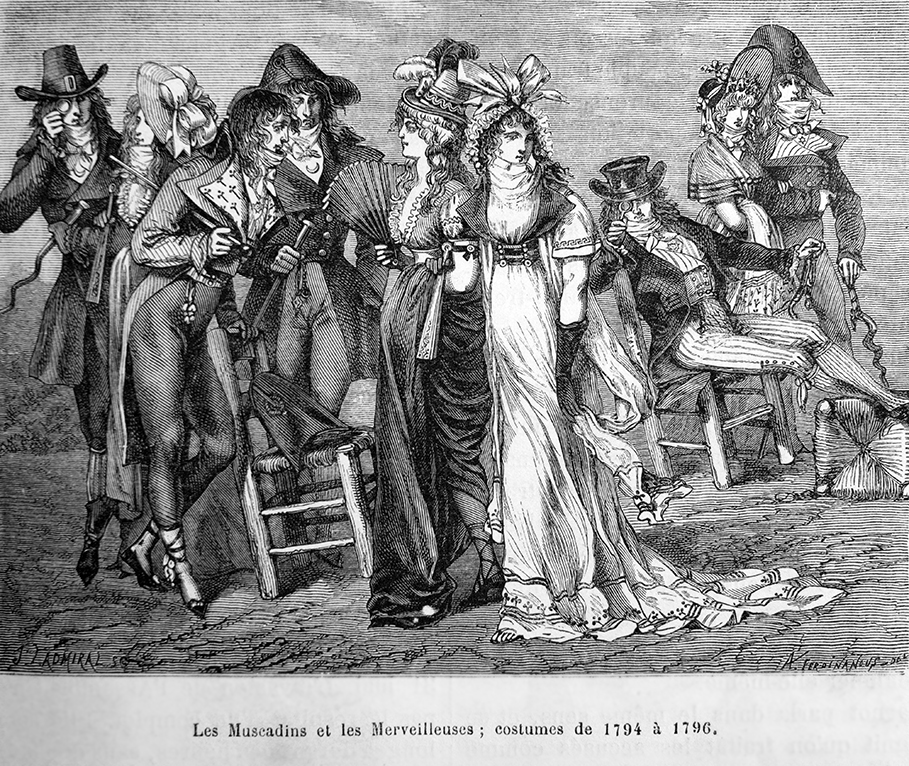
Muscadin, used as a nickname, referred during the French Revolution to a young royalist man who adopted an eccentric dress style.
In women’s fashion, drawing inspiration from ancient mythology, the Merveilleuses emerged, dressed – or rather undressed – in the Greek or Roman style. There were ‘Ceres-style’ and ‘Minerva-style’ tunics, ‘Galatea-style’ frock coats, and ‘Flora-style’, ‘Diana-style’ and ‘Omphale-style’ dresses. Made of light, even diaphanous fabrics, these dresses were too clingy to have pockets sewn into them.
At times, they wore huge hats; at others, they styled their hair short and curly, like that of Roman busts. The fashion queens of the day were Thérèse Tallien, Joséphine de Beauharnais, Juliette Récamier, Germaine de Staël, and others.
Eager to attract more attention, several of the Merveilleuses came up with the idea of appearing in the promenades and public gardens clad only in sheer gauze dresses light and diaphanous that they seemed as indecent to the public eye as complete nudity. Faced with general disapproval, these ultra-Merveilleuses gave up wearing them.