
Joseph-Louis Lagrange (1736–1813) was an Italian mathematician, mechanical engineer and astronomer who became a naturalised French citizen.
His research in mathematics, applied in particular to celestial mechanics, took him from Turin to Berlin, where he lived for twenty-one years, and then to Paris, where he spent the last twenty-six years of his life and became a French citizen.
Recognised early on as one of the greatest mathematicians of his time, his work was honoured with numerous awards, such as the prize granted by the Paris Academy of Sciences on the question: are the irregularities of Jupiter’s four known moons due to their mutual attraction?
In a letter to d’Alembert, Lagrange wrote: “I am in a position to provide a complete theory of the variation of the planetary elements by virtue of their mutual action”, warning him that he might not have time to carry out all the calculations in his lifetime. .
His complete works were compiled into a general treatise in several volumes published in 1785 and 1786 under the title Theory of the Secular Variations of the Elements of the Planets and Theory of the Periodic Variations of the Motions of the Planets.
Present in Paris during the Revolution, he said of his scientific colleague and friend Lavoisier, who was executed during the Reign of Terror: “It took a moment to cut off his head, and a century will not be enough to produce one so well made.”
An asteroid, a lunar crater and a street in Paris bear his name.
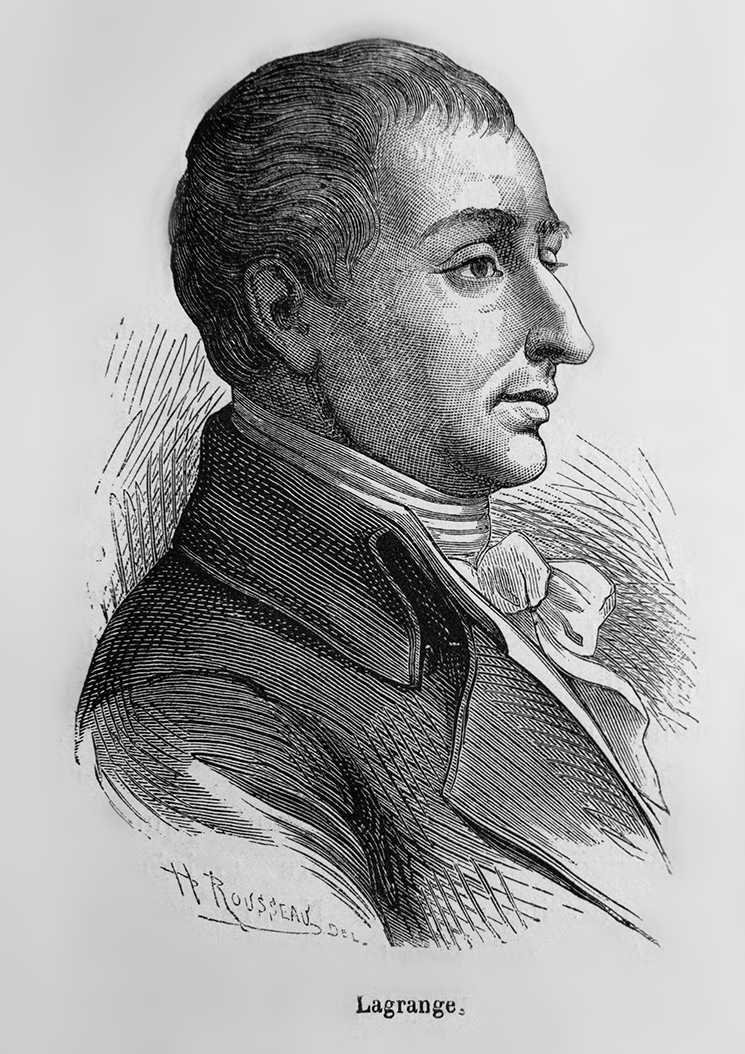
Portrait of Lagrange
- XXL.tif /3945 x 5583 / 129M°
- M jpeg / 1945 x 2753 / 2,5M°
From 6,00 €